Sexual and economic monism
The Second SexSexual and economic monism is the explanatory reduction of women’s lives to a single factor—sexuality in Freudian theory or economic relations in historical materialism. Simone de Beauvoir argues that neither framework can account for the unity of an individual life on its own. The body, sexuality, technology, and material opportunities acquire meaning within an existential situation; understanding women therefore requires attention both to those conditions and to the social relations that make women the Other.
The limits of single-factor explanations
Freudian theory, as Beauvoir presents it, can interpret women’s social claims as forms of “masculine protest,” while a Marxist account may treat sexuality as an indirect expression of economic position. These approaches illuminate real dimensions of experience, but their categories cannot contain the concrete person: sexual classifications such as clitoral and vaginal, like class classifications such as bourgeois and proletarian, do not explain an individual life in its entirety. Beauvoir rejects Freud’s sexual monism and Engels’s economic monism for the same reason: each isolates one explanatory domain from the human reality in which it takes shape.
Her criticism is not a dismissal of psychoanalysis or historical materialism. Psychoanalysis matters because the person exists as a body and experiences that body in relation to other bodies; materialist analysis matters because existential possibilities take concrete form through available resources, especially those opened or restricted by technology. But neither sexuality nor technology explains anything by itself. Bodily strength, the phallus, and tools acquire value within a world of values and projects through which people seek to go beyond what is given.
Existential situation and the body
Beauvoir’s alternative places the person’s projects and freedom at the center without making the body or material conditions disappear. The body is not an isolated biological destiny: it is experienced within a world shaped by relationships, values, and practical possibilities. Similarly, material circumstances matter not as a complete explanation of human life but as the conditions through which a person’s aims can be pursued or frustrated.
This framework clarifies how bodily experience can be real while its meaning is socially formed. Beauvoir describes the adolescent girl’s puberty as an experience in which the body becomes suspect to her; anxiety leads her to scrutinize it, and that anxiety can intensify physical disorders and pain. She also argues that the physiological characteristics of women do not, by themselves, bar them from professions. The handicap arises through the perspective imposed on the body and the wider situation that gives bodily differences their social force.
History, work, and dependence
The economic dimension of women’s subordination appears not as an abstract class position but through concrete relations of labor and dependence. Employers welcomed women’s labor partly because women accepted lower wages, while male workers often saw that low-paid labor as a threat to their own interests. Beauvoir argues that solidarity between women and male workers was therefore not automatic: women’s integration into unions helped them defend their interests without being cast simply as competitors in the labor force.
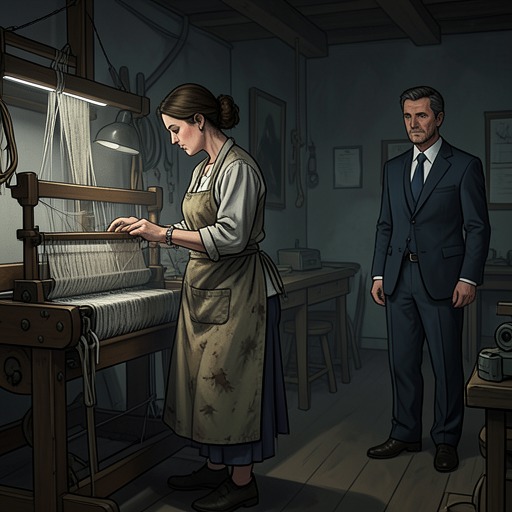
The burden also persists inside households. A French peasant woman may share her husband’s responsibilities, interests, and property and may even exercise considerable authority at home, yet her daily work encompasses care of animals and land, heavy field labor, cooking, washing, mending, pregnancy, and childcare. She rises at dawn to feed the animals and serve the men’s first meal before moving between domestic work and the fields; she has little time for her health or leisure. This example makes the limits of an economic account that counts productive labor without fully registering the reproductive and domestic work that constrains women’s lives.
Marriage and work can also combine formal opportunity with continuing dependence. Beauvoir describes women seeking to reconcile family life and a profession while facing economic inequality and the temptation of marriage as an easier route to security. The expectation that women should please men helps sustain their dependence, even as paid work offers a possible means of emancipation. Neither employment nor economic position alone accounts for the whole situation: the social prestige of marriage, gendered expectations, and restricted opportunities shape what independence can mean in practice.
The Other and the problem of collective agency
Beauvoir’s account extends beyond the opposition between sexuality and economics to ask why women have been subordinated despite being as numerous as men. Unlike a minority whose position follows a particular historical event, women have been subordinated throughout recorded history, and their difference has often been treated as a natural condition rather than a changeable social arrangement. That apparent naturalness makes women’s subordination seem harder to undo, even though Beauvoir insists that nature is no more immutable than historical reality.
Women also lack some of the conditions that have enabled other oppressed groups to organize collectively. Beauvoir contrasts women with proletarians, who can organize around labor, and with groups who can draw on a shared history, culture, religion, or place. Women are dispersed among men and connected to particular fathers or husbands through home, work, economic interests, and social position. Class and race further divide them: bourgeois women may find common cause with bourgeois men rather than working-class women, and white women with white men rather than Black women. These divisions help explain why women have not consistently constituted themselves as a collective subject able to reverse the relation that makes them the Other.
Freedom as the measure
Beauvoir ultimately evaluates institutions by the concrete possibilities they offer individuals, not by claims that women are happy in conditions of dependence. Her existentialist standard is freedom realized through projects and an ongoing movement toward other freedoms. When a person’s transcendence is forced back into immanence, the result is oppression and frustration; women’s particular dilemma is that they are autonomous beings in a world that presses them to accept themselves as inessential and subordinate.
Sexual and economic monism therefore fails because it converts partial explanations into complete destinies. Beauvoir retains what biology, psychoanalysis, and materialist history can show, while insisting that none can stand alone. The decisive question is how bodily life and material conditions are lived within a social world—and whether that world lets women act as subjects with possibilities of their own.